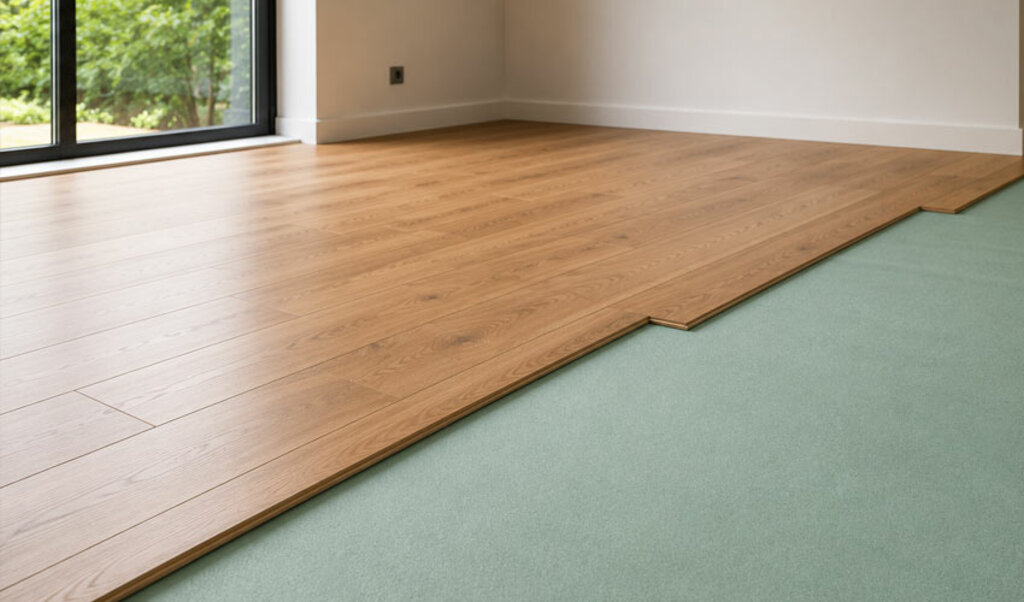
Noise transmission through floors is one of the most common complaints in flats, converted properties, and any home with more than one storey. Footsteps, dropped objects, and even voices can carry between floors far more than most people expect — and the underlay beneath a wood or laminate floor plays a genuinely significant role in how much of that noise gets through.
Airborne Sound vs Impact Sound
Understanding the difference between these two matters because they're addressed differently. Airborne sound travels through the air — voices, music, general ambient noise — and is typically reduced through sound-absorbing materials and barriers. Impact sound is generated by physical contact with the floor — footsteps, dropped objects, furniture being moved — and travels through the solid structure of the building itself, which makes it harder to control than airborne sound. Most domestic noise complaints between floors in a flat are impact sound, which is exactly what acoustic floor underlay is designed to address at the source, before it ever reaches the floor structure below.
What Acoustic Underlay Actually Does
Underlay sits between the flooring and the subfloor, and a genuinely acoustic underlay does more than just add a soft layer — it's engineered to absorb and dampen the vibration from footfall before it transfers into the structure. Beyond noise reduction, most acoustic underlays also add a degree of thermal insulation and, in many cases, integrated damp protection — worth checking for on any underlay you're choosing primarily for noise, since getting both in one product simplifies installation.
Acoustic Underlay Options We Stock
Isocheck Impact Mat: A Dedicated Mass-Loaded Vinyl System
For the most demanding sound-reduction requirements, Isocheck Impact Mat 300 is a genuine three-layer acoustic system — two layers of high-density mass-loaded vinyl sandwiching an isofiber core — specifically engineered to reduce both impact and airborne noise through timber floors and staircases. This is a different category of product to a standard roll underlay, and it's laid directly over the subfloor in a brickbond pattern, completed with matching insulation strip and flanking band to isolate the floor from the room's perimeter. This is the option worth considering where sound transmission is a serious, specific concern — a shared floor with a neighbour below, or a particularly noise-sensitive room.
Combined Sound and Moisture Underlays
Several ranges combine acoustic performance with a built-in moisture barrier in one product, which is the more common choice for most domestic laminate and engineered installations. QuickStep's Transitsound, Unisound Combi and Silentwalk all reduce hollow tapping noise while including a damp-proof membrane, and Duralay's Technics 5 and Timbermate Excel Silver offer specific tested dB ratings — Technics 5 at 28dB, Timbermate Excel Silver at 23dB — giving you a real, comparable figure to check against a building's sound requirements rather than a vague marketing claim.
Levelling Panels for Uneven Subfloors
Where the subfloor itself is uneven, Techni-Board panels are dust- and fibre-free polystyrene boards used alongside a standard underlay, not instead of it, and are particularly suited to click-joint flooring where loose fibres can interfere with the locking mechanism.
Choosing the Right Underlay for Noise Reduction
A few practical questions narrow down the right choice:
- Is this for a flat or a room above another occupied space? If sound transmission to a room below is the main concern, look for a specific tested dB rating rather than assuming "acoustic underlay" means the same performance across every product.
- Do you need damp protection as well? Most of the ranges above combine both, but check specifically — not every acoustic underlay includes a moisture barrier.
- Is this going over underfloor heating? Standard acoustic underlay can insulate against underfloor heating rather than letting it transfer through, so check for underfloor-heating compatibility specifically if that applies to your installation.
- Is the subfloor itself uneven? If so, a levelling panel like Techni-Board is worth adding alongside your chosen acoustic underlay, not as a substitute for it.
Installation Basics
Regardless of which underlay you choose, a few installation fundamentals affect the final acoustic performance:
- Ensure the subfloor is clean, dry and free of debris before laying underlay — trapped grit under the underlay can create noise-transmitting bridge points
- Lay underlay from one corner of the room, fitting snugly against the walls
- Stagger seams between rolls or panels where multiple pieces are used, to avoid a continuous joint that can leak sound
- Follow the specific manufacturer's fixing method — taped seams, adhesive, or a lip-and-tape system depending on the product
Common Questions About Acoustic Underlay
What's the difference between impact sound and airborne sound?
Impact sound comes from physical contact with the floor — footsteps, dropped objects — and travels through the building structure. Airborne sound travels through the air, like voices or music. Acoustic underlay is primarily aimed at reducing impact sound at the source.
Do I need Isocheck's mass-loaded vinyl system, or is a standard acoustic underlay enough?
For most domestic installations, a combined sound-and-moisture underlay like QuickStep's or Duralay's range is sufficient. Isocheck's system is worth considering specifically where sound transmission is a serious, particular concern — a shared floor above an occupied space, for example.
Does acoustic underlay also help with thermal insulation?
Many acoustic underlays do add a degree of thermal insulation, though this varies by product — check the specific underlay's stated properties rather than assuming it's automatic.
Can I use acoustic underlay with underfloor heating?
Only if the specific product is rated for it — standard acoustic underlay can insulate against the heat rather than letting it transfer through, which defeats the purpose of underfloor heating.