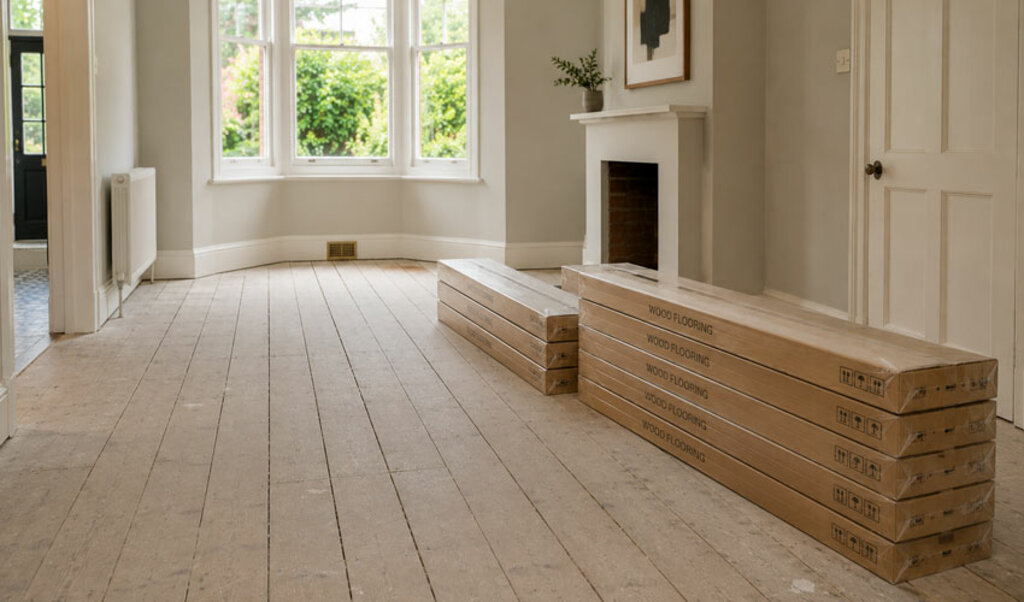
Storing flooring correctly before installation is a step that is easy to overlook but has a significant impact on how the floor performs once it is laid. Wood-based flooring in particular is sensitive to temperature, humidity, and physical stress during storage, and poor storage conditions can cause problems that are difficult or impossible to correct after laying.
Why Correct Storage Matters
All wood-based flooring — solid hardwood, engineered wood, and laminate — contains moisture that is in equilibrium with the surrounding environment. When flooring is moved from one environment to another, it adjusts to the new conditions by absorbing or releasing moisture. This process causes the boards to expand or contract slightly.
If flooring is stored in conditions that are very different from the room where it will be laid, the boards will still be adjusting when they are installed. A board that continues to expand after laying pushes against adjacent boards and can cause buckling. A board that continues to dry out after laying may develop gaps. Allowing the flooring to acclimatise in the room where it will be laid — or in conditions that closely match that room — prevents these problems.
Storage Conditions
The ideal storage conditions for wood-based flooring are:
- Temperature between 15 and 25 degrees Celsius
- Relative humidity between 35% and 65% — matching the expected conditions of the finished room
- Dry environment with no condensation on walls, floors, or surfaces
- Away from direct sunlight, which can cause fading or localised drying
- Off the ground — store packs on timber battens or a pallet to allow air circulation underneath and to protect against ground moisture
Do not store flooring in garages, outbuildings, or unheated spaces unless the temperature and humidity in those spaces closely match the installation environment. A builder's garage in winter is typically cold, damp, and exposed — unsuitable for storing wood flooring even for a short period.
How to Stack Flooring
Flooring packs should always be stored flat and horizontal. Boards stored on end or at an angle can warp or bow under their own weight, particularly if stacked in this position for more than a day or two. Lay packs flat, stacking them with the heaviest at the bottom and no more than five or six packs high to prevent excessive compression of the lower packs.
If you are storing opened or partial packs, ensure the boards are kept flat and protected from dust and debris. Boards left loose and unsupported can twist if stored for any length of time. Wrap partial packs in the original packaging or in a breathable cover — not plastic sheeting, which traps moisture.
Acclimatisation Before Laying
Most solid and engineered wood flooring manufacturers require the product to be acclimatised in the installation space before laying. This typically means leaving the unopened or open packs flat in the room for a minimum period, usually 48 hours for engineered wood and up to seven days for solid hardwood. Check the manufacturer's specific recommendations for the product you are installing.
The room must be at its normal living temperature and humidity during acclimatisation. Do not acclimatise flooring in a room that is cold and unheated — the boards will simply need to acclimatise again once the room is brought up to normal conditions. Ensure any wet trades such as plastering or screeding are fully complete and dry before bringing flooring in to acclimatise.
Laminate and LVT products generally have shorter or no required acclimatisation periods, but storing them in appropriate conditions is still good practice.
Don't Forget the Subfloor Itself
Acclimatising the flooring is only half the moisture picture — the subfloor needs checking too, particularly on a new concrete slab or a screed that hasn't fully cured. Laying flooring over a subfloor that's still releasing moisture can undo all the careful acclimatisation described above, since the boards will absorb that moisture from below regardless of how well they adjusted to the room's air. If there's any doubt about subfloor moisture, a damp proof membrane primer applied before laying is far cheaper than dealing with a buckled floor afterwards.
A little care during storage, acclimatisation and subfloor preparation results in a floor that goes down cleanly and performs well from the first day of use. If you'd rather have this handled professionally, our floor fitting service covers exactly this kind of preparation as part of the installation.
Common Questions About Storing Flooring Before Installation
How long does flooring need to acclimatise before laying?
This varies by product — typically around 48 hours for engineered wood and up to seven days for solid hardwood, though laminate and LVT often need little or none. Always check the specific manufacturer's guidance for your flooring.
Can I store flooring in an unheated garage over winter?
Not recommended, unless the garage's temperature and humidity closely match the room where the floor will be laid. A cold, damp garage is one of the most common causes of acclimatisation problems.
Do I need to test the subfloor as well as acclimatising the flooring?
Yes, particularly on a new or recently laid concrete or screed subfloor — it can still be releasing moisture even if it looks and feels dry, which can affect the floor regardless of how well the boards themselves have acclimatised.