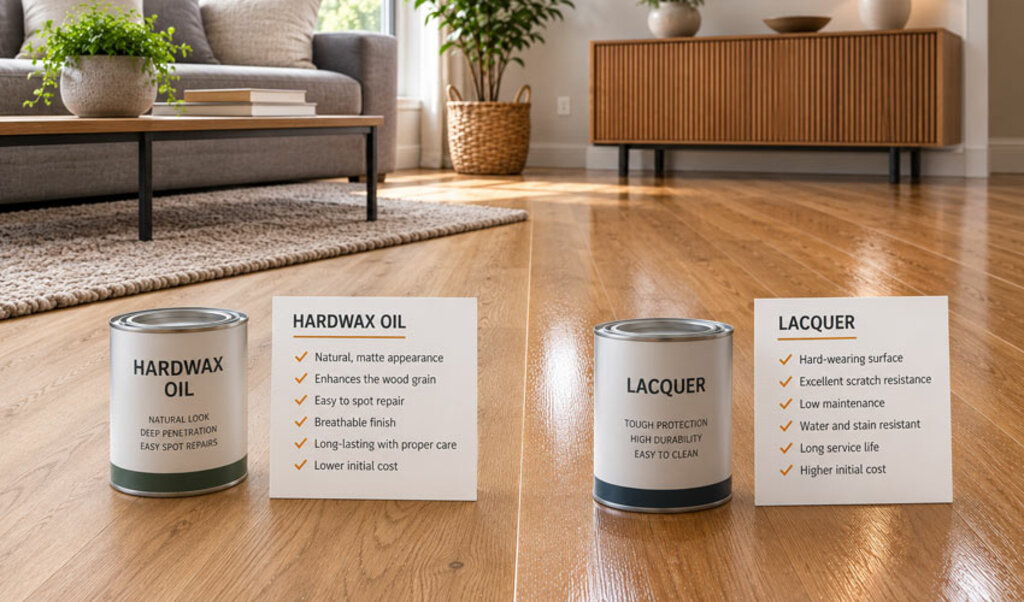
Choosing between hardwax oil and floor lacquer usually comes down to more than just look and feel. For a breakdown of what each finish actually is and how they differ technically, see our guide on understanding the differences between oil, lacquer and hardwax oil; for a room-by-room decision framework, see how to choose the right finish for your home. This guide focuses specifically on the cost, maintenance commitment and environmental trade-offs between the two.
Comparing Lifetime Value, Not Just Sticker Price
Product cost per litre isn't where the real cost difference between these two finishes shows up — it's in application labour, maintenance frequency, and how often you need to return to a full refinish.
Hardwax oil is generally cheaper to apply initially, and is realistic for a confident DIYer to apply themselves, which can meaningfully reduce upfront cost. Products like Osmo Polyx-Oil are widely used precisely because the application method is forgiving. Set against that: a maintenance coat is generally needed every one to two years in busier areas, using a maintenance oil such as Osmo Maintenance Oil or Loba ParkettOil. That's a recurring cost and time commitment the lacquer route doesn't have.
Floor lacquer typically costs more to apply properly, and professional spray application is more common for a really even result, particularly with two-component products like Bona Traffic HD. Against that higher upfront cost, lacquer needs very little ongoing maintenance beyond regular cleaning with the right floor cleaner — no annual maintenance coats. The interval between full refinishes is also generally longer than for an oiled floor under comparable use.
The practical upshot: hardwax oil tends to cost less upfront but more in ongoing time and product over the years; lacquer tends to cost more upfront but less in ongoing attention. Which is "cheaper" over, say, a ten-year period depends heavily on how consistently you'd actually keep up the oil maintenance schedule — a maintenance routine that gets skipped erodes the cost advantage quickly.
Repair Cost: A Genuine Point in Oil's Favour
This is where hardwax oil has a real, quantifiable advantage. A scratch or worn patch on an oiled floor can usually be spot-repaired with a small amount of matching oil, at minimal product cost and no specialist tools. The same damage on a lacquered floor is harder to blend invisibly — a touched-up patch tends to show a different sheen from the surrounding aged finish, so a proper repair often means a wider area needs to be screened and recoated, or in some cases the whole room. For households where scuffs and scratches are inevitable — young children, pets, high footfall — this repair-cost difference is worth weighing seriously against lacquer's lower day-to-day maintenance.
Environmental and VOC Comparison
Modern water-based products in both categories have significantly lower VOC (volatile organic compound) emissions than older solvent-based formulations, so the "oil is greener than lacquer" assumption doesn't hold as cleanly as it used to. A two-component water-based lacquer, such as Bona Traffic HD or Loba 2K Supra A.T., has a genuinely low VOC profile, comparable in many respects to a water-based hardwax oil.
Where hardwax oil retains a real environmental edge is in repairability, extending the life of the existing finish — spot-repairing rather than resanding and recoating a whole floor means less product used and less waste generated over the finish's lifetime, all else being equal.
Which Wins on Cost Depends on Your Situation
- Planning to DIY, comfortable with periodic maintenance: hardwax oil is likely the lower lifetime cost
- Want to install once and largely forget about it: lacquer's lower ongoing maintenance may work out more cost-effective over time, despite the higher upfront cost
- High risk of scratches and scuffs (kids, pets, high traffic): hardwax oil's cheaper, easier repairs are a genuine cost advantage worth weighing heavily
- Renting out the property or selling soon: lacquer's lower maintenance burden and longer interval between full refinishes may suit a landlord or seller better than a finish that needs upkeep they won't be around to manage
Common Questions About Hardwax Oil vs Lacquer Cost
Is hardwax oil always cheaper than lacquer over time?
Not necessarily — it's often cheaper upfront and if you DIY the application, but the ongoing maintenance coats add up over the years. Lacquer costs more initially but needs far less ongoing product and effort, so the cheaper option over a decade depends on how consistently you'd keep up oil maintenance.
Why is a scratch cheaper to fix on an oiled floor than a lacquered one?
An oiled floor can usually be spot-repaired with a small amount of matching oil applied directly to the mark. A lacquered floor's repair tends to show a different sheen where it's been touched up, so a proper fix often needs a wider area screened and recoated.
Is one finish type genuinely more environmentally friendly than the other?
The gap has narrowed significantly — modern water-based lacquers have low VOC emissions comparable to water-based hardwax oils. Hardwax oil's real environmental advantage is that spot repairs extend the finish's life without a full resand, generating less waste over time.