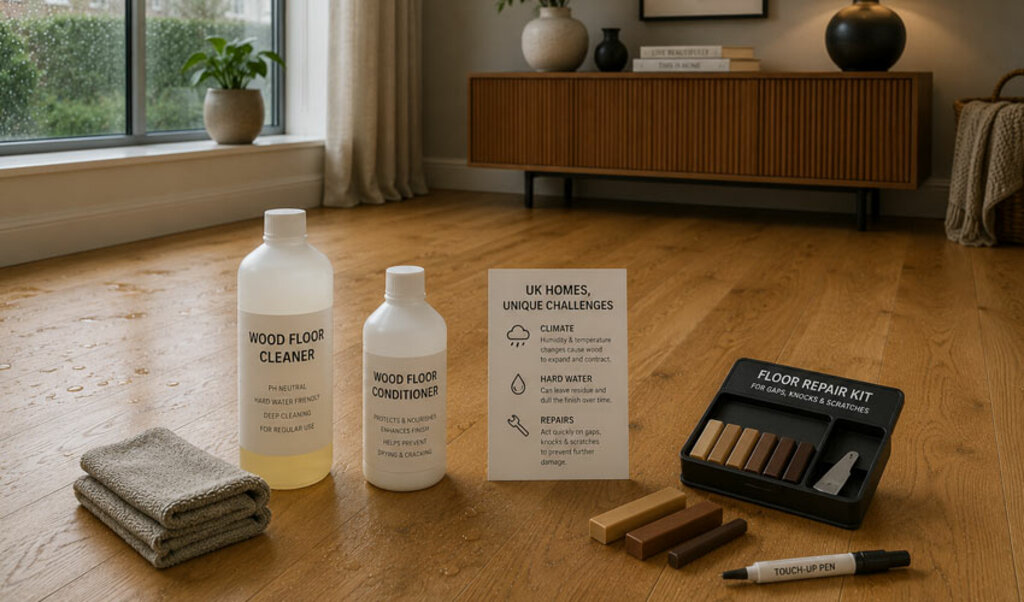
Wood flooring brings warmth and elegance to any home, but the UK's particular climate — variable humidity, hard water in many regions, and centrally heated homes running dry in winter — creates specific challenges that generic wood-care advice often misses. This guide focuses on those UK-specific factors. For the day-to-day cleaning steps and product choice by finish type, see our guide to cleaning and maintaining a wood floor.
Why the UK's Climate Is Genuinely Different
Britain's weather swings between damp winters and drier summers more than many people realise indoors, even though it feels mild compared to more extreme climates. Central heating running through winter creates arid indoor air that pulls moisture out of wood, causing boards to shrink and gaps to open between them. Come summer, higher ambient humidity can cause the reverse — boards expanding and pressing together, sometimes cupping if the movement is significant. Neither is necessarily a fault in the floor; it's a predictable response to seasonal indoor conditions, and it's worth expecting rather than being alarmed by.
Hard water, common across much of England, adds another factor specific to cleaning. Mineral deposits left behind by hard water can build up on a floor's surface if you're using an unsuitable cleaner or too much water, leaving a dull, slightly cloudy residue over time — this is one reason a dedicated, correctly-diluted wood floor cleaner matters more than it might seem.
Managing Seasonal Humidity Swings
- Winter (dry indoor air): a humidifier can help keep relative humidity from dropping too low, and a hygrometer is a cheap way to actually check rather than guess — a stable range of roughly 40-60% relative humidity is a reasonable target for most wood floors
- Summer (more ambient moisture): good ventilation, particularly in kitchens and bathrooms where moisture concentrates, helps prevent the floor from absorbing excess humidity from the air
- Check expansion gaps around the room perimeter periodically — if they've closed up completely, humidity is likely too high for the floor's comfort; if they've opened wide and stayed that way, it may be worth investigating rather than assuming it's normal seasonal movement
Cleaning for Hard Water Areas
If you're in a hard water area, a couple of small adjustments make a real difference. Use less water than you think you need — a barely damp mop avoids leaving enough moisture behind for minerals to deposit as it dries. A cleaner genuinely formulated for wood floors, rather than a generic all-purpose product, is worth the small extra cost, since generic cleaners are more prone to leaving a filmy residue that then attracts more dirt.
Protection Measures Worth Prioritising in the UK
- Entrance mats — genuinely more important here than in drier climates, since British weather means wet, gritty shoes coming indoors far more often through the year
- Felt pads under furniture — replace them regularly rather than assuming they last indefinitely; worn pads pick up grit and become abrasive
- Window coverings in south-facing rooms — UV exposure fades and can dry out a finish over time, even under UK sunlight levels, so blinds or curtains in strongly sun-exposed rooms help protect the finish long-term
- Radiator awareness — avoid placing flooring directly against radiators without a thermostatic valve managing the heat, since constant localised drying can stress the boards nearest the heat source
- Careful winter de-icing near external doors — never use rock salt near wood flooring; track-in from salted pavements can be abrasive and, combined with moisture, damaging to the finish
Repairing Minor Damage
Small scratches and marks don't need a full refinish. For an oiled floor, blending a scratch in is usually straightforward — apply a small amount of the matching oil directly to the mark. For a lacquered floor, or for gaps and small holes rather than surface scratches, a colour-matched wax repair stick — such as Morrells' soft or hard wax sticks — can blend a small mark in without needing to open a can of finish at all. For gaps between boards, a resin filler mixed with sanding dust gives an exact colour match, though this only works once a floor has actually been sanded and fresh dust is available.
Larger areas of damage — warped boards, deep staining, or genuine water damage — are a different matter, and usually mean either individual plank replacement or a proper refinish rather than a DIY fix. Matching grain and finish to the surrounding floor at that scale is a job worth getting a professional opinion on.
When to Consider Professional Refinishing
Even a well-maintained wood floor eventually shows real wear — significant dulling across large areas, deep or widespread scratching, or noticeably uneven colour. Timing varies enormously by traffic and how consistently the floor has been cared for, so there's no single fixed interval that applies to every home. If you're at the point of considering a refinish rather than a refresh, our guide on refreshing a floor without full sanding helps you judge which route actually fits your floor's condition — a genuine refresh is often enough, and considerably less disruptive and costly than a full resand.
If professional help is what you need, our floor fitting service can advise on and carry out the work.
Common Questions About Wood Floor Care in the UK
Why does my wood floor develop gaps every winter?
Central heating dries indoor air significantly in winter, causing boards to lose moisture and shrink slightly, which opens small gaps between them. This is normal seasonal movement in most cases and typically closes back up as humidity rises again.
Does hard water actually damage wood floors?
Not directly, but it can leave mineral deposits on the surface if too much water or the wrong cleaner is used, resulting in a dull, cloudy residue over time. Using a properly diluted, wood-specific cleaner and minimal water largely avoids this.
Is it safe to use rock salt near my wood floor in winter?
No — avoid it near entrances with wood flooring. Salt tracked in from outside can be abrasive and, combined with moisture, damage the finish over time.