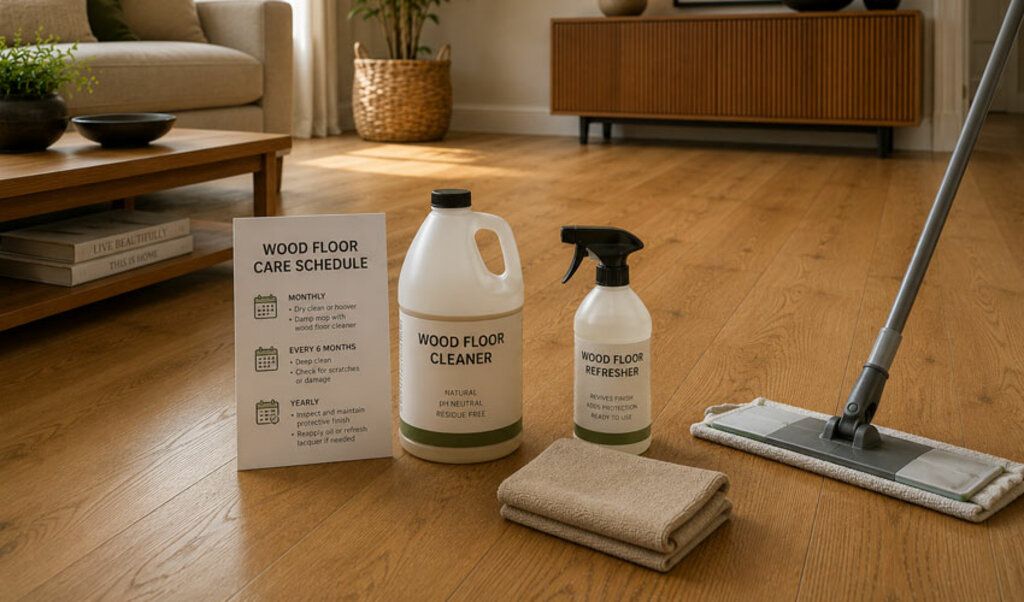
Wood floors reward a bit of routine attention. Most of what keeps a floor looking good doesn't need daily effort — it needs the right things done at the right intervals. This guide sets out a practical monthly and yearly schedule, without repeating every technique in detail — for the full how-to on cleaning methods and product choice, see our guide to cleaning and maintaining a wood floor.
Monthly Routine
- Weekly sweeping, monthly thorough clean — dry sweep or dust mop weekly to remove grit, with a more thorough clean each month
- Damp mopping with the right cleaner — use a cleaner matched to your floor's actual finish: a pH-neutral cleaner like Bona Wood Floor Cleaner for lacquered floors, or a low-pH option like Bona Soap or Osmo Wash & Care for oiled floors — using the wrong type on the wrong finish repeatedly can dry the wood out or dull the surface
- Spot cleaning spills immediately — don't wait for the monthly clean to deal with a spill; standing liquid can penetrate at board edges
- Checking for scratches and marks — minor scratches on an oiled floor can often be spot-repaired with fresh oil; on a lacquered floor, small marks are harder to blend in and may need to wait for a proper refresh
- Dusting skirting boards and beading — easy to overlook, but dirt accumulating here eventually finds its way back onto the floor
A Quarterly Checkpoint Worth Adding
Between the monthly routine and the yearly deep-dive, it's worth a quick seasonal check every few months — this is the gap most floor care advice skips, but it catches problems while they're still small.
- Look along the floor at a low angle in good light — this reveals dulling, scuffing or unevenness in the finish far more clearly than looking straight down, and is the easiest way to catch a lacquer starting to wear before it's obvious in normal use
- Check gaps between boards — some seasonal gapping is normal as humidity shifts, but note whether gaps are opening more than in previous years, which can signal a humidity or subfloor issue worth investigating
- Re-felt any furniture pads showing wear — pads left in place for months pick up grit and become abrasive themselves; a quick check every few months is more effective than replacing them once a year
- Reassess entrance mats — mats compress and mat down with use, becoming less effective at trapping grit; a mat that's flattened out is due for cleaning or replacing
Yearly Routine
- A proper deep clean — once a year, move furniture and clean the whole floor thoroughly with the correct finish-matched cleaner, followed by a dry pass to remove any residue
- Assess whether the finish needs refreshing — a floor that's started looking dull but isn't damaged or worn through doesn't need a full resand. A maintenance coating or refresher — such as Bona Freshen Up for lacquer, or a wax oil refresher for oiled floors — can restore shine at a fraction of the cost of resanding. See our guide on refreshing a floor without full sanding for how to judge which route your floor needs.
- Check for moisture damage — particularly in kitchens, bathrooms, or anywhere prone to humidity; look for warping, cupping or discolouration and address it early
- Consider full refinishing if genuinely worn — most quality finishes last several years before a full sand and recoat is needed, but the exact interval depends heavily on foot traffic and how well the monthly routine has been kept up
- Check furniture placement — indentations from static furniture legs are worth addressing annually with felt pads or a rearrangement, before they become permanent
A Few Habits Worth Keeping Year-Round
- Use rugs with non-slip backing in high-traffic areas to reduce wear
- Keep indoor humidity reasonably stable — extremes in either direction cause more floor movement than a stable, moderate level
- Encourage shoes off at the door — a simple habit that meaningfully reduces the grit that causes most surface scratching
When to Stop Following a Schedule and Call for Help
A routine only goes so far. A few signs mean it's time to look beyond regular cleaning and maintenance:
- Boards that feel soft, spongy or move underfoot — this usually points to moisture damage beneath the surface, not something a surface clean or refresh will fix
- A finish that's peeling or flaking rather than just dulling — this indicates an adhesion failure in the coating itself, which needs a proper resand rather than a maintenance coat over the top
- Persistent gaps that don't close back up in humid months — occasional seasonal gapping is normal, but gaps that stay open year-round can point to a subfloor or acclimatisation issue from installation
- Recurring dark staining in one spot — often a sign of a slow, repeated moisture source (a plant pot, a pet's regular spot, a leak) rather than general wear, and worth addressing at the source before treating the floor
Catching these early, rather than pushing through with routine cleaning alone, usually means a smaller and cheaper fix.
Common Questions About Wood Floor Care Schedules
Do I really need to clean my wood floor monthly, or is that overkill?
A monthly thorough clean is a reasonable baseline for most homes, but weekly dry sweeping matters more day-to-day — grit is the main cause of surface wear, and removing it regularly does more good than an occasional deep clean alone.
How do I know if my floor needs refreshing or a full refinish this year?
If the finish is dull but intact — no bare patches, no flaking, no rough texture — a refresh coat is usually enough. If there's visible wear through to bare wood, that points to a full resand instead.
Is it normal for my floor to need refinishing every few years?
It varies significantly by traffic level and how consistently the floor has been maintained — a well-cared-for floor in a lower-traffic room can go much longer between refinishes than a busy hallway.
What's the difference between normal seasonal gapping and a real problem?
Small, temporary gaps that open in dry winter months and close again in more humid conditions are normal board movement. Gaps that stay open year-round, or keep getting wider, are worth investigating rather than assuming they'll self-correct.